Pages In This Blog

Friday, February 10, 2012

VEENA and SARASWATI

नादाब्धेस्तु परम्पारम न जानाति सरस्वती 
The Sanskrit verse says that the 'Naada' (Swar) is so deep and unfathomable that even the goddess of knowledge Saraswati can not reach to the bottom of it!


VEENA
SARASWATHI VEENA
 Any portrait of Goddess Saraswathi is not complete without Veena in her hands. It deserves such a divine place beside the Goddess. The most appropriate another name the goddess is 'Veena Vaadini', the goddess with a Veena in her hand. 
Veena is a stringed instrument as we know. Do you know what are the unique features of Veena, what it is made up of and how it is played

              Veena is a stringed instrument used in Carnatic music.It dates back to the Vedic period approximately 1500 BC. The word Veena in India was a term used to denote 'stringed instruments'. The  sound is produced by the vibration from the plucked string. Both the hands are used to play this instrument. The unique feature of this instrument is unlike other instruments (percussion and wind instruments). The left hand is prominently used while playing it.

           Veena has four main stringsand are tuned to 'Sa','Pa', (middle) 'Sa' (upper) and 'Pa'(upper). There are three more strings for the Tala, played by the little finger of the right hand. So Veena is such a scientific instrument that many parts of our hand and our brain work simultaneously. The pressure exerted on the frets by the left hand and striking the respective string by the right hand produces sound. Earlier Veenas were played vertically. The great Indian Carnatic music composer and Saraswathi Veena player Muthuswami Dikshitar started the tradition of playing Veena horizontally.

           Veena has 24 frets. It is 4ft in length. It has a large resonator (Kudam) carved out of a log, tapering hollow neck (dandi) with 24  frets made of brass or bell metal. These are set in black wax on wooden tracks. It has a tuning box culminating in a downward curve and an ornamental Dragon's head (yali). The seven strings are now made up of steel.

Written by Ananya Pramod.

Thursday, February 9, 2012

The Rousing Sound Of Chenda


(Video by Shivani Rao)


HISTORY  OF  CHENDA....


Chenda  is  an ancient  musical  instrument. It has  been  in  use  since  prehistorical  times . Its  presence  was  first  discovered  in  Hindu  mythologies , paintings  and  sculptures .  In  earlier  days , Chenda  was  used  by  the  messengers  of the kings to announce  important  information  and  also  to  declare  war . Traditionally , it  was  called as  'Asura  Vadyam ' which  means  an  instrument  which  cannot be  used  in  harmony .
1] GURU  DAKSHINA 
Dakshina is offrerd to the Guru at the time of 
commencing  the performance in public. 
In  Kerala , it  was  used  at  the  time  of  festivals. and  also in  temples. Its sound is still believed to be important on any auspicious  ceremony. It has become an integral part  of  their  cultural  activities  and  rituals . 

This Indian drumming instrument  is  capable  of  producing  very  complex  rhythms . The  sound  emitted  by  Chenda  is  loud  and  high . The sound  produced  can  be  heard  easily  up to the distance of more  than  3  kilometers. This  instrument  is  very  heavy  in  weight . Chenda  has  also  been  in  use  in  the  'Tantric'  rituals  of  goddess  Mahakali  from  the  previous  times . 


In Kerala the children are taught this divine art at their early age. The rituals are very religious and important. The photograph shows how "DEEKSHA" is taken from a GURU in the presence of the community and the headmen.


2) GURU plays Chenda with Shishyas after the rituals.
 [ This photo is taken at Payyanur in Kerala during a Chenda Melam ]


                 This is a small clip of  chenda melam

3)  CHENDA 
4) The Chenda and the Sticks


So friends, now you all are aware of the instrument called CHENDA. But I still want to give you all some more information. It goes this way........


In picture 2 you  will find a line of  few  people at the back of the children . They are providing supporting rhythmic sounds for Chendas. Some instruments which are played are  Kombu  (kind of trumpet), Kuzhal  and Elathalam . These are Malayalam names.
KUZHAL  - on the left side  


ELATHALAM


KOMBU


By: Bhavani .H

What Is Chenda?

CHENDA


Chenda is a  South Indian percussion instrument. It is mainly used in Kerala while accompanying  the classical dance of Kathakali, Koodiyattam and it also one of the 'Panjavadyam'. It is also used in South Karnataka, Tulu Nadu with the dance form of Yakshagana.
The two faces are fixed with the help of  rope

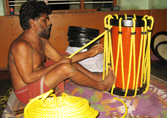
It is a cylindrical drum made of jackfruit wood. It has a circular frame made of bamboo or the wood of palm tree. The skin of an ox is soaked in water and fixed on the circular frame. Then this skin is placed on the wooden drum and stretched using rope made of coir or nylon. It's length is 2ft and the diameter is 1ft. 
They are hung vertically on the shoulders like that of a side drum . The upper face of the drum or Chenda is beaten with sticks to create rhythmical sound. It produces very loud sound.
It is also called Asura Vadya.

TYPES OF CHENDA
There are mainly three types of Chenda -

  • Uruttu Chenda(for playing variation)
  • Vukku Chenda(for playing basic rhythm)
  • Acchau Chenda


Sunday, February 5, 2012

TABLA, A Popular Percussion Instrument Of India

With the advent of "Khyal" in north Indian music Tabla became an essential part of it. During Mughal period it came on the classical stage. Ustad Sidhar Khan is believed to be the first exponent of this instrument. Attractive face of the compositions and sweetness in sounds made Tabla a very popular instrument..The tradition of  Tabla is prevalent in the form of "GURU-SHISHYA PARAMPARA" for centuries. The special feature of this instrument is the sounds are produced with the help of fingers. Very rarely the arms are raised to create a syllable. From right fingers the sounds (Varna) produced mainly are 'Na', 'Tu', 'Tat', 'Ta', 'Tit' etc. On the left drum the common Varnas are 'Ghe' and  'Kat'. The combination of both right and left is very attractive with Varnas like 'Dha', Dhin', 'Tin', 'Tirkit' and much more!

 Written by Nandan Herlekar

TAAL

In Indian way Taal is an expression or the medium of measuring time in music.
 It is in abstract form and is felt only when "THEKA" of a Taal is actually played on with the help of a percussion.
 In Sanskrit texts Taal is described as "TAALAH KAAL KRIYAMAANAM".
In ordinary sense Taal is rhythm. 
A study of Taal in Indian music is combined with the grammatical values of the language. In short Taal matches the meter or a "VRITTA" in poetry. Meter in a poem is maintained till the ending line. It is an established rule and is a natural process of grammar.
 While a poem is sung the meter becomes audible through percussion. 
Actual time taken while singing one line is valued with "LAGHU" or "GURU MATRA". 
In some cases "AKSHAR GANA" also is taken into account. 
The stress given on the first "VARNA" is followed by another through out the song in rhythmic continuation.
Everyone loves to tap foot on the rhythmic cycle. 
It is a natural process seen everywhere. 
Recitation of a poem does not necessarily need "Tone" (SWAR in Indian way) but rhythm is always needed for true impression. Importance of "TAAL" lies here.


Written by Nandan Herlekar