Pages In This Blog

Wednesday, February 15, 2012

GHATAM, An Amazing Taal Vaadya

Ghatam

Ghatam

What is Ghatam?

Ghatam is a percussion instrument used in south India for classical music. It is an earthen pot. Ghatam is a Sanskrit word. To play this instrument the artiste should have a great sense of rhythm. The player uses his fingers, thumbs, palms and heels of their hands to produce sound on its outer surface. When the mouth of the pot is hit with open hands, an airy low pitch bass sound is produced which is called as Gumki. A variety of tones can be produced by hitting different areas of the pot with different parts of hands. Sometimes artiste presses the mouth of the pot against his belly to deepen the tone of the bass stroke. It is an another way of producing Gumki. Ghatam is an accompanying instrument played along with Mridangam in a concert of Carnatic music. It is very interesting to see when the player throws Ghatam in air for three times in attaining a 'TIHAEE' of the TAAL. 
Some other versions of Ghatam are played in Konkan area while singing Bhajans and Arati. This is usually called a Ghat. Its mouth is covered with goat skin.
Even though it is an ordinary Indian domestic clay pot, it is a specially made musical instrument.

Types of Ghatam

There are two types of Ghatam  seen in Carnatic music concerts.
1.Madras Ghatam
This Ghatam is a light weighed pot. Very little force is required to play             it.Generally fast patterned compositions are played on it.
2.Manamadurai Ghatam
This is a heavy and thick pot with tiny shards of brass mixed in the                clay. Since it is heavy, it is difficult to play on this kind of Ghatam. It produces sharp metallic ringing sound which is very soothing to ears.


Strokes

The areas of sound production on the Ghatam are bottom , middle and upper portion of the belly, as well as at the neck and the mouth of it.


Enchanting Sounds on a Ghatam

Tha -With left hand. Middle, ring and little finger's combined stroke on the upper portion.Bellykha - With right hand's middle, ring and little fingers combined stroke on the upper bell.Ti - With left index finger on upper belly.Na - With right index finger on upper belly.Ku -  With left thumb on the neck.Na - With right thumb on the neck.Thom - A stroke of left wrist on the neck.Ghum - A stroke of right wrist on the neck.Gumki - The palm stroke on the mouth > bass tone. 


Written by Shivani Rao


Tuesday, February 14, 2012

CARNATIC WIND INSTRUMENTS AEROPHONES

There are many varieties in the wind instruments' category. Here you can find a Nagaswaram (but it resembles with Shehanai of north India) and other accompanying instruments. A notable thing is, the drone player does not stop blowing for even a single second throughout a piece is played by the Nagaswaram player. The drone resembles a bugle with attached blowing pipe. Other accompanying instruments are a longer and thin drum, a metallic gong, and smaller Chenda like percussion.
                    FLUTE


Flute is one of the most praised and the oldest wind instruments of south India. We always see Shri Krishna's picture with a flute. Ancient Sanskrit verses state that flute is the source of  'Swarajnana - the knowledge of music'. Flute is also known as  Bansuri, Venu, Vamshi, Kuzhal and  Murali. Flute was one of the most common instruments during the Vedic period. Flute is played for a solo performance as well as used as an accompaniment for vocal music. The performer takes part in the  instrumental ensembles too.
Flute is found in every music of the world. In Carnatic music it has a special tunning made to suit the scale. It is made of bamboo and it has 6-8 holes apart from the mouth hole. These holes are arranged in a straight line. These holes vary in long flutes and in short flutes.
Long flutes have rich ,deep and soft tone whereas short flutes have high pitched tones. Vertical flutes are used in Indian folk music and horizontal flutes are played in classical music of the north and south India. North Indian classical flutes are longer compared to the one is used in Carnatic music. Some ancient flutes were made-up of bones.


Saxophone, a western aerophone has become an integral classical musical instrument of  south India. It is played on auspicious occasions like religious ceremonies or during marriage. In this clip one can see it is accompanied by Tavil for rhythmic beauty. A religious procession with deity sitting in a Palakhi.


Monday, February 13, 2012

MRIDANGAM, The Heartbeat Of Carnatic Music.


                                      Mridangam
What is Mridangam?
The Mridangam is a primary percussion instrument of Indian Classical  Music (Carnatic). It has double ended drums to played with both hands.
The body of this instrument is usually made up of wood of Jack fruit tree. It has dense and heavy wood that gives the Mridangam a weight of 10 to 12 kilograms


Origin of Mridangam

In Sanskrit "Mrid" means soil. The original Mridangam was made of soil. "Angam" is the body. The origin of Mridangam goes back to the Indian mythologies wherein it is stated that Lord Nandi (the Bull God), who was the escort of Lord Shiva was a master percussionist and used to play the Mridangam during the performance of the " Taandav " dance by Lord Shiva.


How it is made?
The present day Mridangam is made of a single block of wood. It is made either from a log of jack wood or redwood. It is made hollow to suit the sound effect to be created. Jack wood has more fibrous structure than any other types of wood. The packing of the fibers is also very high. The pores present in jack wood is less when compared to others. The pore size and distribution of the material can be inversely proportional to the modulus of the wood. The density of jack wood is also less when compared to other woods.


How it is played?
The Mridangam is played primarily by using the index, middle, ring and small fingers of both hands while the thumb finger is used as a support element. The palm of the right hand is also used mainly while playing the stroke "Plam or Jham". To play the strokes "Nam" and "Dhim", it should be kept in mind that when the index finger is used to play these strokes, the ring finger should always be positioned  in between the outer rim and the inner black ring on the right side of the Mridangam.


In this video Master Sunadhakrishna of VIII th std. in KV2, Mangalore has played beautifully the intricate Taniyavartanam in Aaditaal. One can see and hear the varieties of this Taal in the form of Theka, Korave and Mohara.


Written by Vivek Raj & Rahul Rao

Sunday, February 12, 2012

VEENA, A Sacred Instrument

 
Veena is a sacred musical instrument. It is always seen in the hands of the goddess Saraswati. In this video my Guru Mrs. Savithri Rao is teaching me a Keerthana Sarasara Samarai in Raga Kuntal Varali.

TYPES OF VEENA

Veenas can be classified on the basis of frets.

WITH FRETS
Rudra Veena

Rudra veena is a plucked string instrument used in Hindustani music.Rudra veena literally means the Veena dear to Shiva'. Dr.Lalmani Misra modified this as the Shruthi Veena to establish Bharat's Shadja Gram and obtain the 22 Shruthis from it. One of the women who play Rudra veena is Smt.Jyothi Hegde from .....
A beautiful Rudra Veena


Saraswathi Veena
It is a plucked string instrument used in Carnatic music.There are 7 strings in this kind of Veena.Some notable Vainikas (players) are Veene Sheshanna, Iyer Brothers and....

FRETLESS
Vichitra Veena
Vichitra Veena is a plucked string instrument used in Hindustani music. It is a modern form of the ancient Ektantri Veena.(Single stringed Veena). There are 4 main strings and 5 secondary strings (chikaris). There are 13 sympathetic strings underneath them. 5 octaves can be covered in this Veena. It has peacock heads on the either side of its narrow ends. Some of the performers of Vichitra veena are Lalmani Misra, who also played Dadras along with the traditional compositions on Veena. He was creator of a famous Raga Madhukali.  Dr.Radhika Umdekar Budhkar is noted as the 1st lady Vichitra Veena player.
Vichitra Veena


Chitra Veena
Chitra veena ,a fret less lute for Carnatic music is also called as Gotuvadyam.The name Gotuvadyam was given by Pandit Sakha Rama Rao. Its origin can be traced back to Bharata's Natya Shastra. It has 20 or 21 strings. Some performers are Budaloor Krishnamurthy Shastri,Veena Doraiswamy, Seetha Doraiswamy who plays both Chitra veena and the Balakokila, a smaller version of Chitra Veena.
Chitra Veena

GUITAR
Mohan Veena
Though this instrument is not classified in Carnatic music, I tempt to mention it since it is  a new invention made by the famous Pandit Vishwa Mohan Bhat.
Mohan Veena is a slide guitar used in Indian classical music. It is a modified Archtop guitar invented by Pandit Vishwa Mohan Bhat and he named it so. It has 20 strings having 3 melody strings, 5 drone strings and 12 sympathetic strings. Great performers are a famous fusion artiste Harry Manx, Pandit Satish Khanwalkar, Matt Malley, Salil Bhat, the son and Shishya of Pandit Vishwa Mohan Bhat, the inventor of Mohan Vena.
Written by Ananya Pramod  

Friday, February 10, 2012

VEENA and SARASWATI

नादाब्धेस्तु परम्पारम न जानाति सरस्वती 
The Sanskrit verse says that the 'Naada' (Swar) is so deep and unfathomable that even the goddess of knowledge Saraswati can not reach to the bottom of it!


VEENA
SARASWATHI VEENA
 Any portrait of Goddess Saraswathi is not complete without Veena in her hands. It deserves such a divine place beside the Goddess. The most appropriate another name the goddess is 'Veena Vaadini', the goddess with a Veena in her hand. 
Veena is a stringed instrument as we know. Do you know what are the unique features of Veena, what it is made up of and how it is played

              Veena is a stringed instrument used in Carnatic music.It dates back to the Vedic period approximately 1500 BC. The word Veena in India was a term used to denote 'stringed instruments'. The  sound is produced by the vibration from the plucked string. Both the hands are used to play this instrument. The unique feature of this instrument is unlike other instruments (percussion and wind instruments). The left hand is prominently used while playing it.

           Veena has four main stringsand are tuned to 'Sa','Pa', (middle) 'Sa' (upper) and 'Pa'(upper). There are three more strings for the Tala, played by the little finger of the right hand. So Veena is such a scientific instrument that many parts of our hand and our brain work simultaneously. The pressure exerted on the frets by the left hand and striking the respective string by the right hand produces sound. Earlier Veenas were played vertically. The great Indian Carnatic music composer and Saraswathi Veena player Muthuswami Dikshitar started the tradition of playing Veena horizontally.

           Veena has 24 frets. It is 4ft in length. It has a large resonator (Kudam) carved out of a log, tapering hollow neck (dandi) with 24  frets made of brass or bell metal. These are set in black wax on wooden tracks. It has a tuning box culminating in a downward curve and an ornamental Dragon's head (yali). The seven strings are now made up of steel.

Written by Ananya Pramod.

Thursday, February 9, 2012

The Rousing Sound Of Chenda


(Video by Shivani Rao)


HISTORY  OF  CHENDA....


Chenda  is  an ancient  musical  instrument. It has  been  in  use  since  prehistorical  times . Its  presence  was  first  discovered  in  Hindu  mythologies , paintings  and  sculptures .  In  earlier  days , Chenda  was  used  by  the  messengers  of the kings to announce  important  information  and  also  to  declare  war . Traditionally , it  was  called as  'Asura  Vadyam ' which  means  an  instrument  which  cannot be  used  in  harmony .
1] GURU  DAKSHINA 
Dakshina is offrerd to the Guru at the time of 
commencing  the performance in public. 
In  Kerala , it  was  used  at  the  time  of  festivals. and  also in  temples. Its sound is still believed to be important on any auspicious  ceremony. It has become an integral part  of  their  cultural  activities  and  rituals

This Indian drumming instrument  is  capable  of  producing  very  complex  rhythms . The  sound  emitted  by  Chenda  is  loud  and  high . The sound  produced  can  be  heard  easily  up to the distance of more  than  3  kilometers. This  instrument  is  very  heavy  in  weight . Chenda  has  also  been  in  use  in  the  'Tantric'  rituals  of  goddess  Mahakali  from  the  previous  times . 


In Kerala the children are taught this divine art at their early age. The rituals are very religious and important. The photograph shows how "DEEKSHA" is taken from a GURU in the presence of the community and the headmen.


2) GURU plays Chenda with Shishyas after the rituals.
 [ This photo is taken at Payyanur in Kerala during a Chenda Melam ]


                 This is a small clip of  chenda melam

3)  CHENDA 
4) The Chenda and the Sticks


So friends, now you all are aware of the instrument called CHENDA. But I still want to give you all some more information. It goes this way........


In picture 2 you  will find a line of  few  people at the back of the children . They are providing supporting rhythmic sounds for Chendas. Some instruments which are played are  Kombu  (kind of trumpet), Kuzhal  and Elathalam . These are Malayalam names.
KUZHAL  - on the left side  


ELATHALAM


KOMBU


By: Bhavani .H

What Is Chenda?

CHENDA


Chenda is a  South Indian percussion instrument. It is mainly used in Kerala while accompanying  the classical dance of Kathakali, Koodiyattam and it also one of the 'Panjavadyam'. It is also used in South Karnataka, Tulu Nadu with the dance form of Yakshagana.
The two faces are fixed with the help of  rope

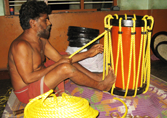
It is a cylindrical drum made of jackfruit wood. It has a circular frame made of bamboo or the wood of palm tree. The skin of an ox is soaked in water and fixed on the circular frame. Then this skin is placed on the wooden drum and stretched using rope made of coir or nylon. It's length is 2ft and the diameter is 1ft. 
They are hung vertically on the shoulders like that of a side drum . The upper face of the drum or Chenda is beaten with sticks to create rhythmical sound. It produces very loud sound.
It is also called Asura Vadya.

TYPES OF CHENDA
There are mainly three types of Chenda -

  • Uruttu Chenda(for playing variation)
  • Vukku Chenda(for playing basic rhythm)
  • Acchau Chenda